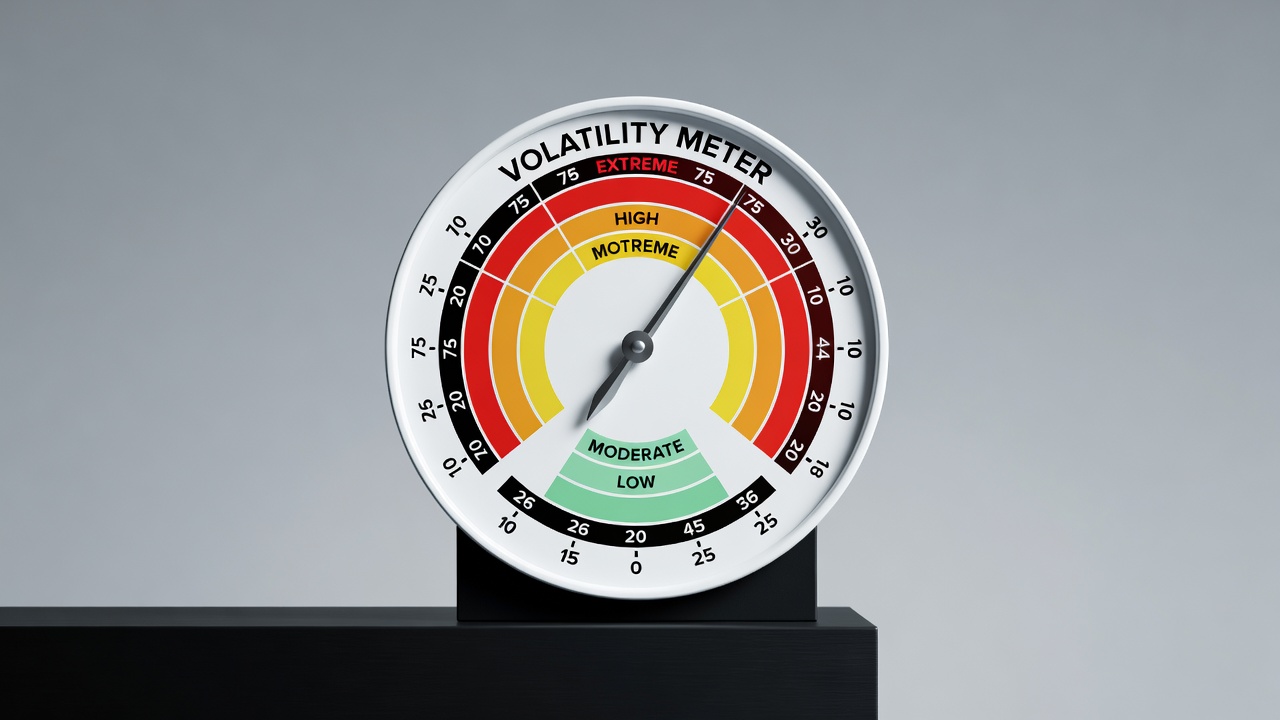
A slot description says: "High volatility. Big wins rare but impactful." Another says: "Low volatility. Small frequent wins."
These descriptions sound like they mean something. They do. They just do not mean what you think they mean.
What Volatility Actually Is
Volatility is the variance in outcomes over a sample of spins.
Low volatility: outcomes cluster around the expected value. You get steady small wins. Variance is low.
High volatility: outcomes deviate from expected value. You get long dry spells then sudden big wins. Variance is high.
Over an infinite sample, both converge to the RTP. A low-volatility 96% RTP slot and a high-volatility 96% RTP slot both return 96% eventually.
But in a finite sample (your actual play session), low and high volatility feel completely different.
How This Feels
Low volatility slot: You bet $1 a hundred times. You hit small wins often (maybe 40% of spins). Your bankroll declines slowly.
High volatility slot: You bet $1 a hundred times. You hit large wins rarely (maybe 5% of spins). Your bankroll drops fast. Or climbs fast if you get lucky.
The Studio Labels
Studios (Pragmatic Play, NetEnt, Microgaming) rate their slots on a scale. Usually 1 (low) to 5 (high).
These labels are chosen for marketing. A "5" rating game is marketed to players who want the "thrill" of big wins. A "1" rating game is marketed to players who want "entertainment value."
No studio says: "This game is designed to empty your wallet slightly slower than our high-volatility game."
But that is the actual difference.
The Strategic Question
Should a player choose based on volatility?
If you have a small bankroll ($50) and limited time (one hour), low volatility is better. You stay engaged longer.
If you have a large bankroll ($1,000) and are chasing big wins, high volatility is better. You might hit something worthwhile.
If you have a medium bankroll ($200) and no edge-seeking, it does not matter. You lose the same percentage eventually.
The Math
A low-volatility game with 96% RTP at 2 variance returns $0.96 for every dollar wagered. Over 100 spins of $1, you expect $96 back.
A high-volatility game with 96% RTP at 8 variance also returns $0.96 per dollar. But you might return $110 or $80 depending on luck.
The expected value is the same. The probability distribution is different.
The Feeling
Low volatility feels like losing slowly. You see wins frequently, but they are small. You feel like you are playing, not like you are losing.
High volatility feels like winning big or losing catastrophically. You get long stretches of nothing then a massive win. It is more exciting and more stressful.
Casinos market high-volatility games because the feeling is more engaging. A player on a high-volatility slot will stay longer, hoping for the big win.
The Takeaway
Volatility does not change your expected loss. It changes how the loss feels.
Choose based on personal preference: do you prefer steady small losses or bursty big losses?
But understand: you are not choosing your odds. You are choosing how to experience the same mathematical outcome.