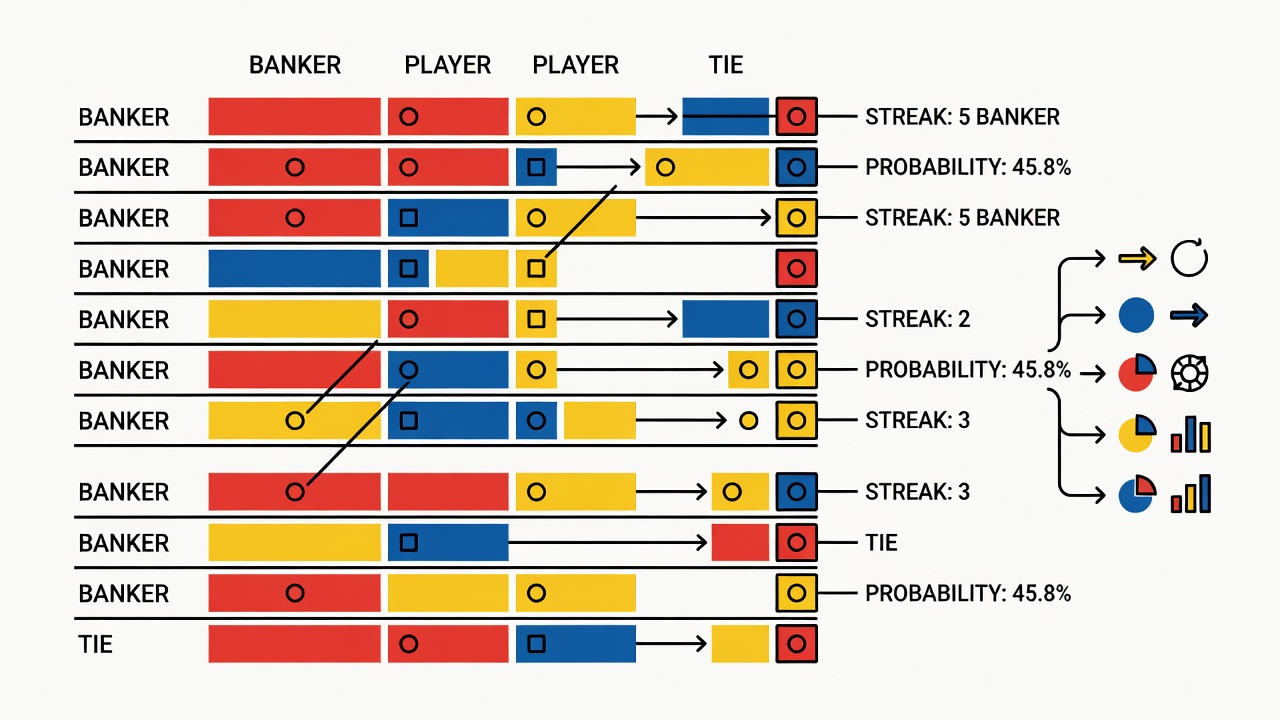
Baccarat streaks are a surveillance gold mine. Not because they prove cheating. Because they prove something worse: how predictably people lose their own money.
I spent fifteen years in the eye watching high-limit baccarat at a major Vegas property. The equipment is synchronized to detect micro-movements, card bends, collusion signals. But the thing that kills players fastest is free. It's called the gambler's fallacy, and it lives in the part of your brain that thinks patterns mean something.
How Players See Patterns That Aren't There
The shoe produces a sequence of outcomes. Banker wins, then Banker, then Player, then Banker, then Player, Player. Your brain locks onto the rhythm. It feels like information. It's not. It's data your pattern-recognition hardware misinterprets as signal.
Here's the mechanical problem: a standard baccarat shoe contains 8 decks, 416 cards. The probability of Banker winning is 50.68%. Player is 49.32%. Tie is 9.51%. These percentages are hardwired into the physical deck. They don't change because you've seen five Bankers in a row.
Yet people bet accordingly. After four Player wins, they load up on Banker. The next shoe produces one Banker, then three Players. The player loses forty thousand. He watched the pattern break. He didn't understand he was watching variance, not a law of physics.
The Roadmap Illusion
Baccarat tracking sheets aren't useless because they're wrong. They're useless because they're true in a way that doesn't help. Yes, that roadmap accurately records what happened. It happened. It's over. The next card doesn't care.
A player at a high-limit table in Macau once asked me, off-the-record, if the pit ever worried about someone predicting the shoe. I laughed. Prediction requires information. Pattern is not information. The shoe is a random walk. Every single card has no memory of the last one.
But tracking sheets work. Not because they predict. Because they give the brain something to do while it loses money. They convert randomness into a story. Stories feel safer than chaos.
The Streak Paradox
Here's what I learned: long streaks happen more often than people think. If you're watching a shoe long enough, you will see eight Bankers in a row at some point. Not because the shoe is biased. Because that's what randomness looks like with enough shuffles. It produces weird runs. It produces silence. It produces whatever it wants.
Players then construct elaborate narratives. The dealer is hot. The shoe is dead. Their wife is in the room now so luck returned. They break in the new shoe. None of this is anything. It's just people assigning stories to noise.
The ones who lasted longest at the tables were the ones who understood this at a gut level. They didn't chase streaks. They bet flat, understood the house edge of 1.06% on Banker, 1.24% on Player, and accepted that long-term results would match the math. They didn't beat the house. But they didn't lose faster either.
Why Casinos Don't Stop This
We let players use tracking sheets because tracking sheets are a sedative. A player filling in boxes feels in control. A player in control places bigger bets. Bigger bets lose more, on average, over a shoe. The math works for us regardless of whether the roadmap is real or imaginary.
I never saw anyone become a winning player because of pattern recognition. I saw them tighten their bankroll management, understand true probability, and accept that baccarat is a game with a built-in house advantage that no pattern dodges. Those players survived longer. They didn't rage-bet. They didn't chase. They treated the shoe like what it is: a mechanical random generator with a slight bias toward Banker.
The house doesn't fear your roadmap. The house fears your discipline.