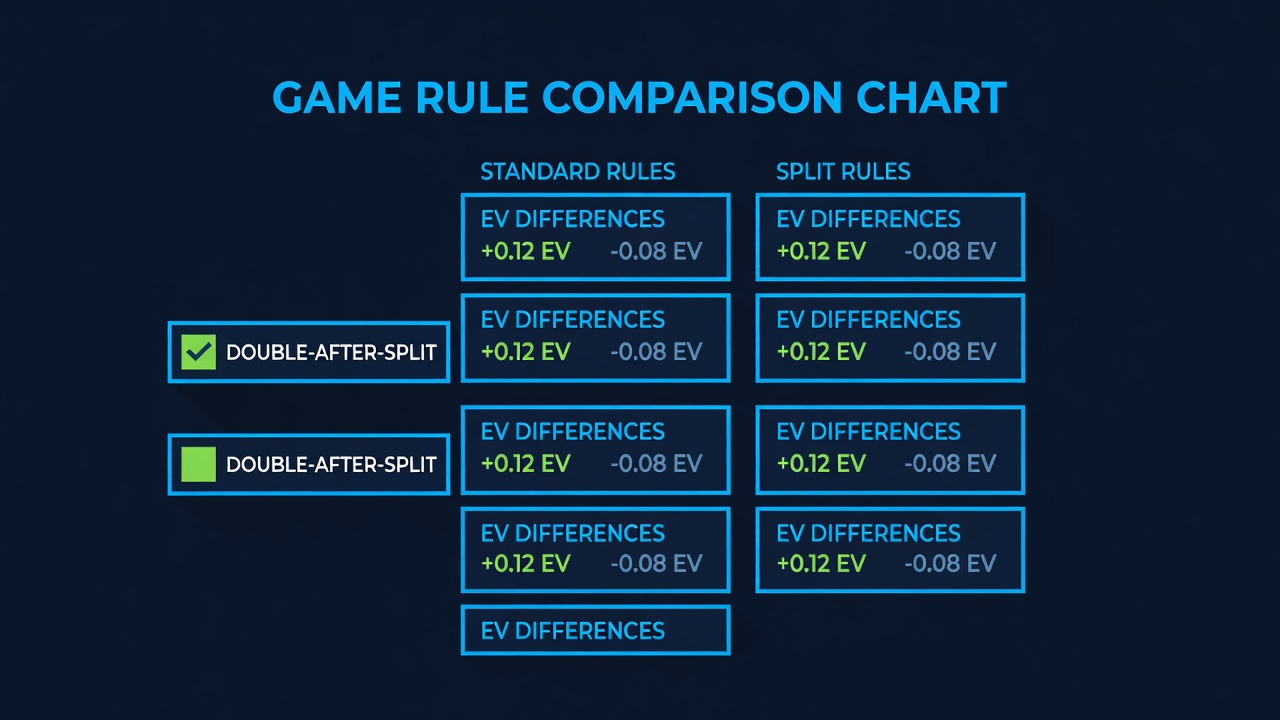
Double-after-split (DAS) is a rule modification that changes the expected value of a blackjack hand by approximately 0.14 to 0.20 percent. That sounds marginal. It is not.
What the Rule Does
Standard blackjack allows you to split pairs. After splitting, you receive new cards on each hand. Most casinos prohibit doubling after splitting. The DAS rule permits it.
The difference: you split eights against a dealer six. You receive a two on the first hand (ten total, now), and you want to double down. Without DAS, you cannot. You must hit or stand. With DAS, you double immediately.
From a basic strategy perspective, there are roughly 16 hands where DAS changes your optimal play. Most are pairs split against middling dealer upcards.
The Mathematical Edge
Basic strategy against a six-deck shoe without DAS: house edge is 0.50 to 0.55 percent. With DAS: house edge drops to 0.36 to 0.42 percent. The difference is not huge, but for a player expecting to stay at the table for several hours, it compounds.
A player wagering $200 per hand over 60 hands plays $12,000 total. Without DAS, the expected loss is $60 to $66. With DAS, the expected loss is $43 to $50. The rule swing is $10 to $20 per session. Over a year of monthly sessions, that is $120 to $240.
Not enough to beat a -EV game. But if you are shopping casinos, DAS is a strong tell of better game rules. It often correlates with other player-favorable rules like early surrender, soft seventeen (dealer hits soft 17), or no re-split aces.
Where to Find It
DAS is standard in most land casinos on the Strip and in Atlantic City. Many European casinos (Paris, London, Malta) offer DAS by default. Online operators vary wildly. Some live blackjack studios offer DAS; others do not. Always check the rule sheet before sitting.
Online casinos often label their variants: "Blackjack DAS," "Blackjack Early Surrender," "Blackjack Soft 17." Read the fine print.
The Kelly Staking Implication
If you use a Kelly criterion model for bet sizing (betting a fraction of bankroll proportional to edge), the difference between DAS and non-DAS games matters at the precision level.
Assume a bankroll of $50,000 and a bet size model that scales with game edge. Against a non-DAS game with -0.50 percent edge, you might size bets to risk 1 percent of bankroll per session. That is $500 per session. Against a DAS game with -0.40 percent edge, the same model might suggest a slightly larger bet size, say $520 per session. The difference is small but real.
The inverse is more important: if you are in a bad game and a good game is available, the variance in edge is not negligible over hundreds of hands. Closing line value in gambling is about consistent selection of games where your theoretical edge is maximized. DAS is a proxy for a casino that has optimized its ruleset for transparency. That is worth something.
Other Rules That Matter More
DAS is good, but not the primary focus. The payoff on a natural blackjack (10:6 vs. 3:2) matters far more. If a casino cuts the blackjack payout to 6:5, all other rules are irrelevant. Do not play that game.
Surrender (early or late) is also more valuable than DAS. Early surrender against ace and ten can shift the edge by 0.60 percent if you use it correctly.
Penetration (how deep into the shoe the casino deals before reshuffling) matters for card counters and for tracking burn-off variance.
The Strategic Takeaway
DAS is a signal. It suggests the operator values player experience and understands that transparent, favorable rules create retention. It is not a reason to play a game you should not play. But if you have identified a blackjack table based on other criteria (fair payoff, good penetration, soft 17 rules), then DAS is a bonus edge that makes the game worth your time.
Casinos that offer DAS typically offer additional player-favorable rules as well. It is part of a package. Seek those packages.