The Unlawful Internet Gambling Enforcement Act of 2006 didn't make online gambling illegal. It made it illegal for banks to process payments to online gambling sites. The distinction is important. No player was ever prosecuted. No site operator was ever convicted for serving American customers.
But the effect was absolute. PokerStars, Full Tilt, PartyPoker: all exited the US market overnight.
What happened next is the fragmentation we live in now.
The European Model
Europe didn't ban online poker. It regulated it. The Malta Gaming Authority licenses operators. The UKGC licenses operators. Germany, France, Spain: each established regulatory frameworks. An operator could be licensed in Malta and serve the entire EU, or obtain country-specific licenses.
The system created unified liquidity in some cases (the UKGC zone is large enough to support major operators) and fragmented liquidity in others (Germany's strict licensing meant fewer operators and thinner games).
From a player perspective: if you're in Europe, you have consistent access to regulated poker sites. Your money is protected. Your disputes are handled by regulators.
The American Fragmentation
After UIGEA, online poker didn't disappear in the US. It fragmented.
Some states explicitly banned it. Some states allowed it for their state-licensed casinos only. Some states ignored it. Nevada, New Jersey, and Delaware created intrastate compacts where players from different states couldn't play against each other.
In 2024, you can play online poker legally in: Nevada, New Jersey, Delaware, Pennsylvania, Michigan, West Virginia, and a handful of other states. But you can't play against someone from a different state. The liquidity is sliced into pieces.
A poker game that had 50,000 players online at peak hours in 2005 now has 5,000 spread across different states and jurisdictions. The games are weaker, but the variance is higher because the talent is more concentrated in any single game.
The Caribbean and Crypto Zones
Curaçao, Malta (for non-EU jurisdictions), and various Caribbean licenses created a "light touch" regulatory zone. Operators could be licensed with minimal compliance and operate globally.
These jurisdictions have eGaming licenses that are rubber stamps. An operator pays a fee, submits some documentation, gets licensed. There's no real oversight.
A player in this jurisdiction has no protection. If the operator disappears with their money, there's no recourse. Curaçao eGaming doesn't have enforcement mechanisms comparable to the UKGC or MGA.
But operators in this zone can offer higher rake returns and less stringent KYC, attracting players who value anonymity over protection.
The Bitcoin Zone
Bitcoin sportsbooks and poker sites operate in a jurisdiction-free space. They claim to be licensed in Curaçao or similar, but their real jurisdiction is cryptocurr currency immutability.
A Bitcoin poker site's "house" is not a physical entity that can be sued. It's a wallet and a server. If the site disappears, the players' Bitcoin is gone.
But Bitcoin poker has thrived because it serves players who value anonymity or who live in places where their home-country poker is restricted. The regulatory vacuum is actually a feature.
The Asian Story
Asia doesn't have unified online poker regulation. The Philippines, under PAGCOR licensing, became a hub for legitimate but unregulated poker sites serving Asian players.
Malaysia, Singapore, and Thailand technically ban online gambling. But enforcement is spotty. Players use VPNs to access offshore sites.
China banned online gambling entirely and enforces it. Players use VPNs. The cat-and-mouse game continues.
From a player perspective: Asian regulation is opaque. You can play, but you're always in a grey zone. Your account might get frozen. Your withdrawal might be delayed. There's no transparency.
The Future Fragmentation
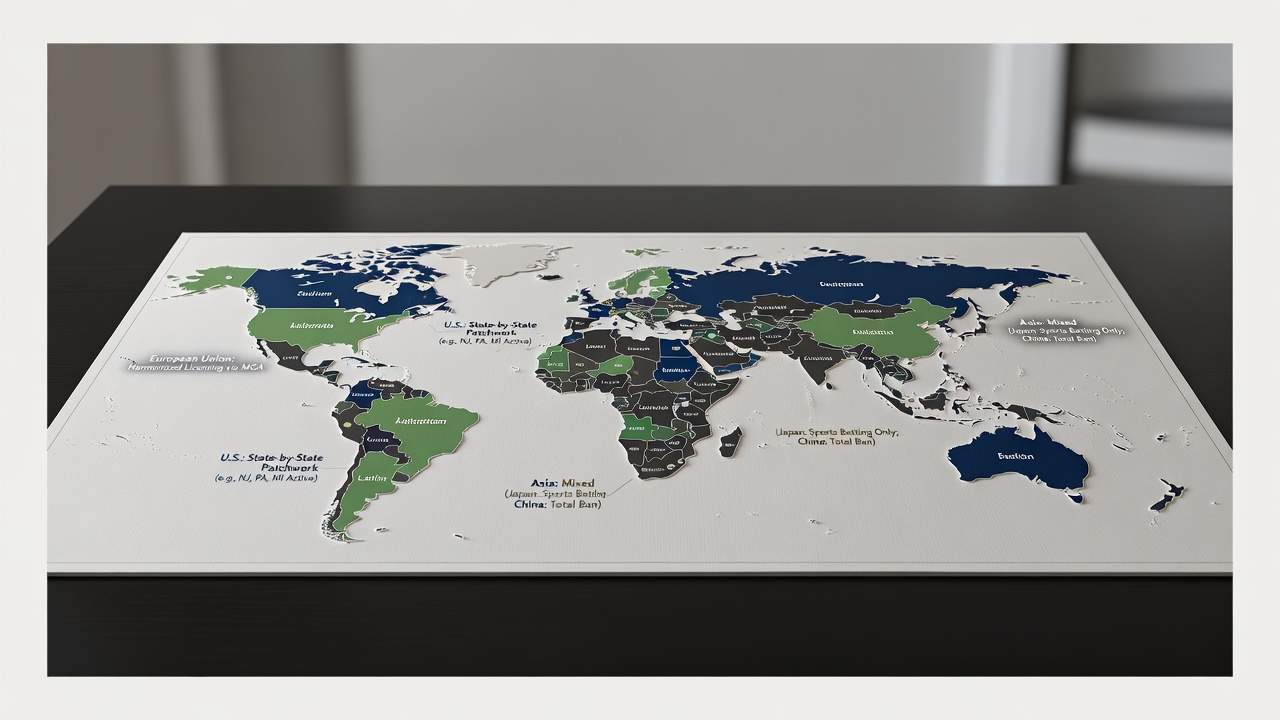
The current situation is: coordinated licensing in Europe, fragmented state regulation in the US, light-touch licensing in Caribbean jurisdictions, and prohibition with workarounds in Asia.
No unified global regulatory framework exists. Every player must understand the jurisdiction they're playing in and accept the protections (or lack thereof) that jurisdiction offers.
A player in the UKGC zone has consumer protection. A player in Curaçao has contract enforcement against a company that may not exist. A player on a Bitcoin site has cryptographic certainty but no legal recourse.
What It Means for Players
Choose your jurisdiction carefully. If you want protection, play in licensed, regulated zones: UKGC, MGA, state-regulated US poker sites.
If you want anonymity or access from a restricted jurisdiction, you're accepting risk for convenience. That's a reasonable tradeoff. Just understand what you're trading.
The regulation picture will probably never unify. Each jurisdiction has different political cultures around gambling. Some want to ban it. Some want to tax it. Some want to ignore it.
The player's job is to understand which rule applies to where they're sitting.