Two in the morning at a mid-tier casino on the Strip. You are standing at a table watching a man play Casino War. The dealer draws a card. The player draws a card. The player's card is higher. The dealer pushes chips forward. The man gathers them. He pulls out his wallet. He sits down again.
Casino War is not a game; it is a mechanism. A mechanism for converting cash into an evening, and the evening into debt.
The Mechanism
A single standard deck is dealt from a shoe. The player receives one card. The dealer receives one card. The higher card wins. If the cards are equal, the player has two choices: surrender half their bet, or go to war.
Goers to war place a second bet equal to the first and receive one more card. The dealer also receives another card. The higher card then determines the winner. There are no bluffs. No strategy. No decision points beyond the initial bet size and the choice to surrender or wage war on ties.
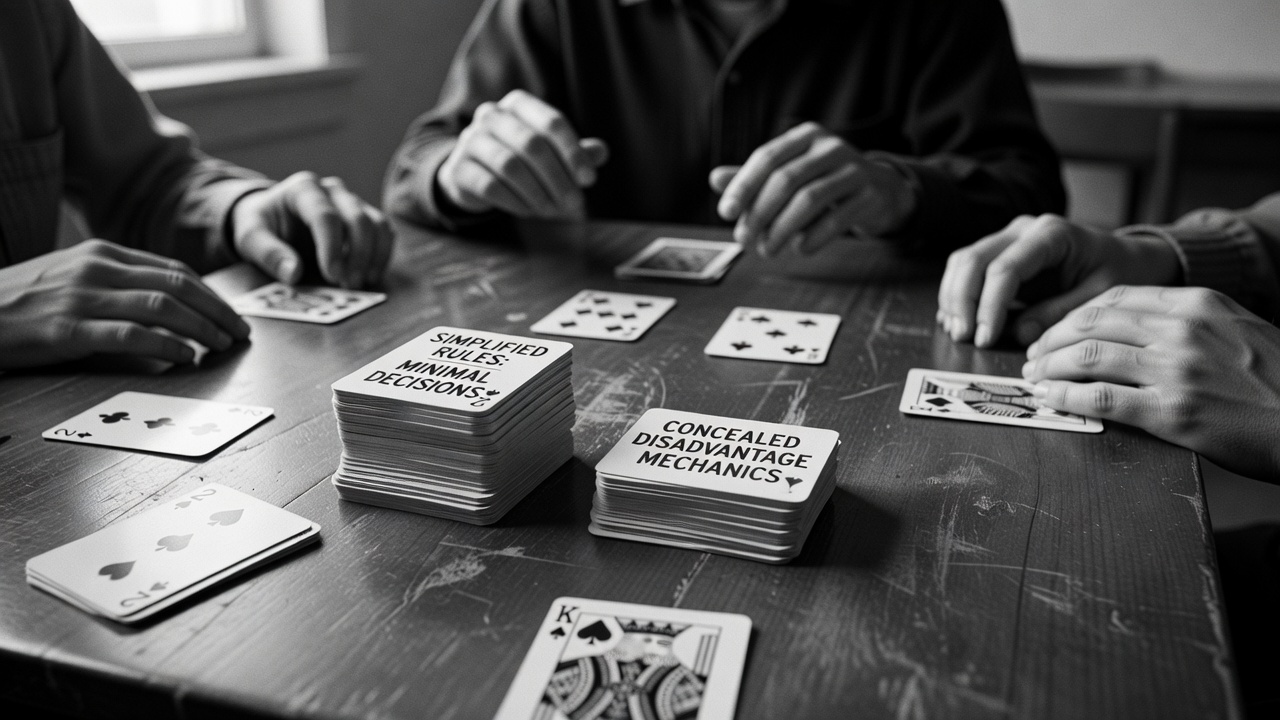
This is intentional. Casino War was designed for players who do not want to think. A man sitting at a blackjack table must understand hitting and standing. A man at roulette must select his numbers. A man at Casino War can simply sit, watch, and let the cards decide. The absence of decision is the game's entire appeal.
The Cost
The house edge on Casino War is 2.88 percent. This is high compared to blackjack (0.5 percent with basic strategy) or baccarat (1.06 percent on banker bets). It is low compared to slot machines (2-15 percent depending on the machine and the casino).
But the edge matters less than the velocity. A Casino War hand is resolved in thirty seconds. Baccarat takes seventy seconds. Blackjack takes ninety seconds. A man playing 100 dollars per hand at Casino War faces 120 hands per hour. At 2.88 percent edge, he expects to lose 345 dollars per hour.
The same man at baccarat faces fifty hands per hour and loses 53 dollars per hour at the same hand size. Casino War extracts money six times faster.
Why would someone play? Simple. Because the decision is made for him. He does not have to think about hitting sixteen against a dealer ten. He does not have to agonize over his numbers. The cards decide. His job is simply to watch and place the next bet.
The Psychology
Casino War is designed for men in a specific mental state: exhausted, slightly drunk, emotionally wrung out, eager for simplicity. A player in this state does not want freedom of choice. Freedom creates doubt. Doubt creates the possibility of mistake. Casino War eliminates doubt. You cannot play badly; you can only lose.
There is something almost therapeutic about this. A man can sit at a Casino War table and lose 500 dollars while feeling, in some strange way, absolved of responsibility. The cards decided. He was merely the spectator.
Where It Exists
Casino War tables are found primarily in casinos catering to casual players: the Golden Nugget, the Stratosphere, regional casinos in the Midwest and South. You will not find it at the Bellagio or the Venetian. The high-limit rooms do not offer it. The rooms where serious players operate do not need it.
Where you find Casino War, you find it in rooms where the average visitor is playing their third day in Vegas, has already lost 2,000 dollars, and simply wants something easy. Casino War provides it.
The Larger Lesson
Casino War exists because casinos understand a truth about human desire: sometimes the appeal of gambling is not the possibility of winning. It is the temporary suspension of consciousness. A man playing Casino War is not playing to win. He is playing to stop thinking about the woman who left him, the job he lost, the money he borrowed to come here.
The game's simplicity is not a flaw; it is the feature. It is the entire reason the game exists. And it is why, year after year, men sit at these tables, watch cards emerge from the shoe, and watch their money move across the felt toward the dealer's window.