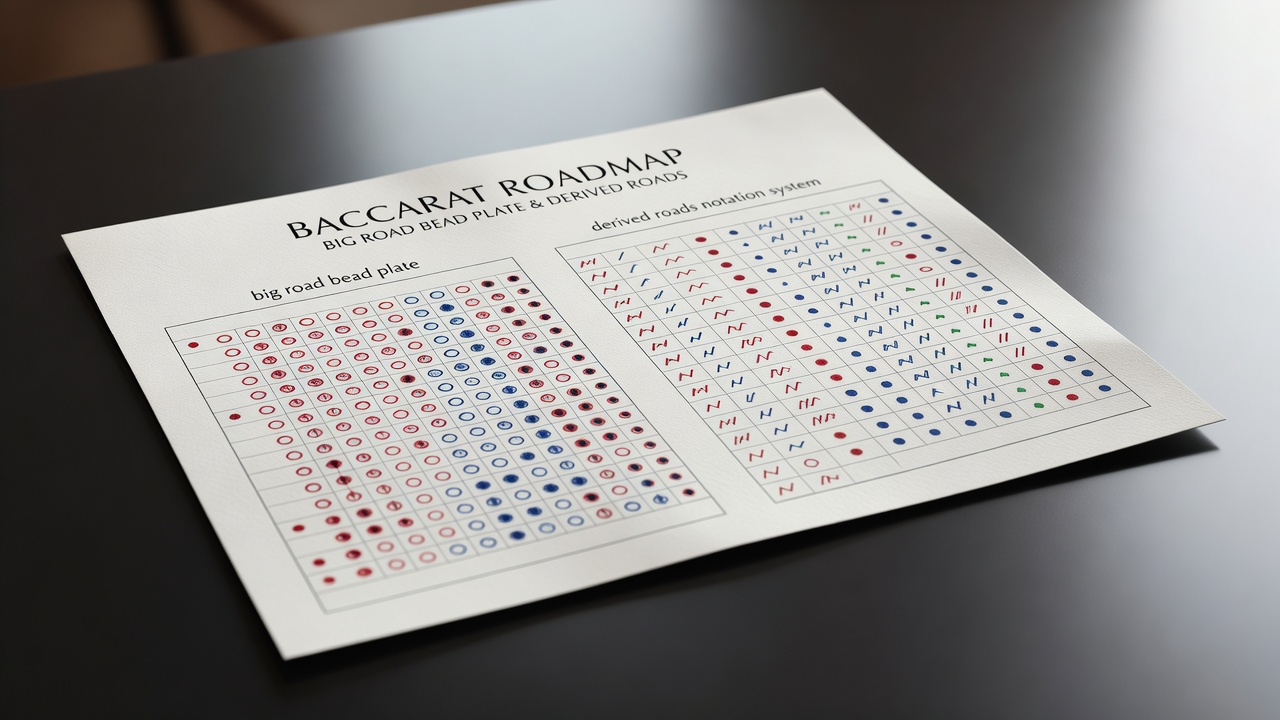
A baccarat roadmap is not a prediction tool. It's a documentation tool that has been reinterpreted as a prediction tool by players who need to believe they're seeing signal in noise.
What Roadmaps Actually Show
The Big Road is the simplest. A column is created for each shoe outcome. If Banker wins, a blue circle is placed. If Player wins, a red circle is placed. Ties are usually skipped or marked separately.
The columns fill down, then move right. Each new shoe starts a new column. Over the course of an eight-deck shoe, you create eight outcomes per shoe. Over a night, you create 50-100 outcomes.
This creates a visual pattern. Five Bankers in a row. Then three Players. Then eight Bankers. The visual is real. The pattern is real. But the pattern is data, not signal.
The Derived Roads Delusion
From the Big Road, players create derived roads. The Dragon, the Tiger, the Bead Plate. These are transformations of the data.
For example: the Dragon shows every other outcome. If the Big Road is B, P, B, P, B, P, the Dragon shows all Bs. The purpose is to identify meta-patterns that might reveal structure the Big Road missed.
But this is pure pattern-matching. You're taking a random sequence, transforming it, and asking "does the transformation reveal predictability?" The answer is almost always no. But the human brain is exceptionally good at finding patterns, so players find patterns anyway.
The Regression Problem
If you play baccarat for a thousand hands tracking the roadmap, you'll eventually see a sequence where the Big Road produced a predictive pattern.
For example: after seeing three consecutive shoes where a 6-person Banker streak was followed by a 4-person Player streak, you might predict that the next shoe will show a 6-person Banker streak followed by a 4-person Player streak.
The shoe produces: 5-person Banker, 6-person Player. You're wrong, but you don't notice the misses. You only remember the hit.
This is the hot-hand fallacy crossed with confirmation bias. You're tracking enough data that coincidental patterns will appear. When they do, you remember them. When they don't, you ignore them.
Why Casinos Let You Track
Roadmaps require paper, pens, and table space. Some casinos provide them. Some don't.
Operators allow roadmaps because roadmaps are a sedative. A player with a roadmap and a pen feels in control. They feel they're investigating something. They feel less like a random person losing money and more like a technician executing a system.
This sense of control increases engagement. Players stay longer when they're tracking. Longer sessions mean more losses.
From the casino's perspective, roadmaps are free retention tools.
The Mathematics Don't Change
The house edge at Baccarat is 1.06% on Banker, 1.24% on Player. This is fixed by the rules of the game, not by the shoe.
Every outcome sequence, no matter how unusual it appears, will over sufficient hands produce results that match these percentages.
A player who plays 1000 shoes tracking an incredibly detailed roadmap will lose approximately 1.06-1.24% of their total wagered. The roadmap provided no edge, no information, no predictive value.
But the tracking itself provided psychological value. The player felt less like they were gambling and more like they were working.
The Historical Context
Baccarat roadmaps originated in Macau. Professional players understood that while the mathematics were fixed, the psychological confidence from tracking was real. Confidence correlates with bigger bets. Bigger bets correlate with bigger losses.
What started as a personal tracking tool became a casino-provided amenity. The casino understood: let the player track, let them feel like they're doing research, and they'll play longer.
The tracking sheet is the casino's marketing material.
What Tracking Actually Reveals
Baccarat roadmaps do reveal one thing: your own biases. If you track a roadmap long enough, you'll discover which patterns you're drawn to. When Banker has won five times, are you more likely to bet Player? That reveals something about your brain, not about baccarat.
Learning your own biases is valuable. But you don't need a roadmap to do it. You just need to pay attention.
The Practical Reality
A player can sit at a baccarat table and track their roadmap for 6 hours, lose 15 dollars per hour in expected value, and walk away feeling like they were executing sophisticated strategy.
A player can sit at a craps table for the same 6 hours, place worse bets, lose 30 dollars per hour, and walk away feeling like they were just getting unlucky.
The roadmap didn't make the first player a better bettor. It just made the losing experience feel different.
If you're going to play baccarat, understand that the roadmap is a history book. It shows what happened. It doesn't predict what will happen. A history book of random events is still a history book of random events.
Track if it helps you feel better. But don't confuse documentation with prediction.