Every so often, someone discovers betting systems and believes they have found the secret to casino profit. The D'Alembert system and the Fibonacci system are two popular examples. Both are completely ineffective.
D'Alembert works like this: you start with a base bet (say, 10 dollars on red). If you win, your next bet is reduced by one unit (to 9 dollars). If you lose, your next bet is increased by one unit (to 11 dollars). The idea is that losses and wins will eventually balance out, leaving you with a small profit.
Fibonacci works differently. You follow the Fibonacci sequence: 1, 1, 2, 3, 5, 8, 13, 21, and so on. You place bets corresponding to this sequence. After a win, you drop back two numbers in the sequence. The idea is similar: exploit variance to come out ahead.
Why They Fail
Both systems share a fundamental flaw: roulette has a fixed house edge of 2.7 percent (on European wheels) or 5.4 percent (on American wheels). No betting system can overcome a fixed house edge because each spin is independent.
Every spin of the roulette wheel has the same expected value: you expect to lose 2.7 percent of your wager (on European wheels). This is true whether you bet 1 dollar or 1,000 dollars, and it is true whether you are on your first bet or your 1,000th.
Betting systems work by changing the order of your bets, not the fundamental expected value. Changing the order does not change the sum of expected values. Over a thousand spins, your expected loss is 2.7 percent of your total wagered amount, regardless of which system you use.
The Bankroll Trap
D'Alembert and Fibonacci can feel profitable for a while because of short-term variance. Over fifty spins, you might come out ahead. But as the sample size grows, the house edge reveals itself.
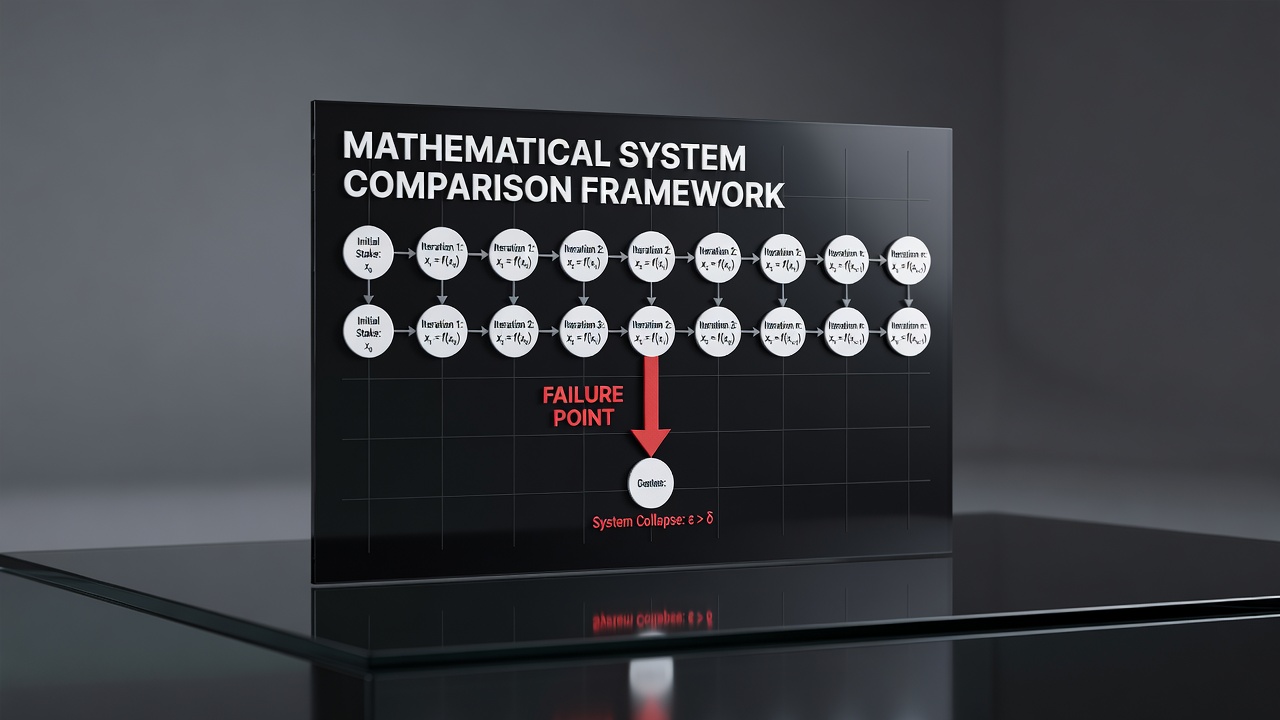
Worse, both systems require escalating bet sizes during losing streaks. In D'Alembert, you increase your bet after each loss. In Fibonacci, you double your bet position after every three losses. During a sustained losing streak (which will inevitably occur), your bet sizes grow exponentially.
You might start with a 10 dollar bet. After ten losses, you might be betting 100 dollars. After twenty losses, you might be betting 500 dollars. Eventually, your bet size exceeds your bankroll.
This is why both systems fail in practice: they require infinite bankroll to survive an unlucky streak. No human has infinite bankroll.
Why People Use Them Anyway
Betting systems persist because they satisfy a psychological need. Humans prefer the illusion of control to the reality of randomness. A betting system feels like a plan. A plan feels better than hoping.
Additionally, both systems sometimes produce short-term profits. A bettor using D'Alembert might win 200 dollars in an evening, attribute it to the system, and never recognize that they got lucky. They return next weekend, lose 500 dollars, and discover that the system does not actually work.
The Verdict
There is no betting system that overcomes the house edge in roulette. Not D'Alembert, not Fibonacci, not any other system yet invented. The mathematics are clear.
If you choose to play roulette, play it for entertainment. Bet flat amounts. Accept the house edge. Do not expect a system to save you.
Roulette is a random game with a fixed house edge. No amount of system sophistication changes this fact.