The genesis is England, 1750s. A game called Hazard, played with two dice, played by men in formal dress in homes with servants. The mechanics are complex. The pace is glacial. It is entirely unAmerican.
But American slaves and immigrant workers found it and simplified it. The simplification removed the aristocratic complexity and kept the speed. This is where craps was born: not in a gentleman's study but in a dock or a field or a basement.
The American Evolution
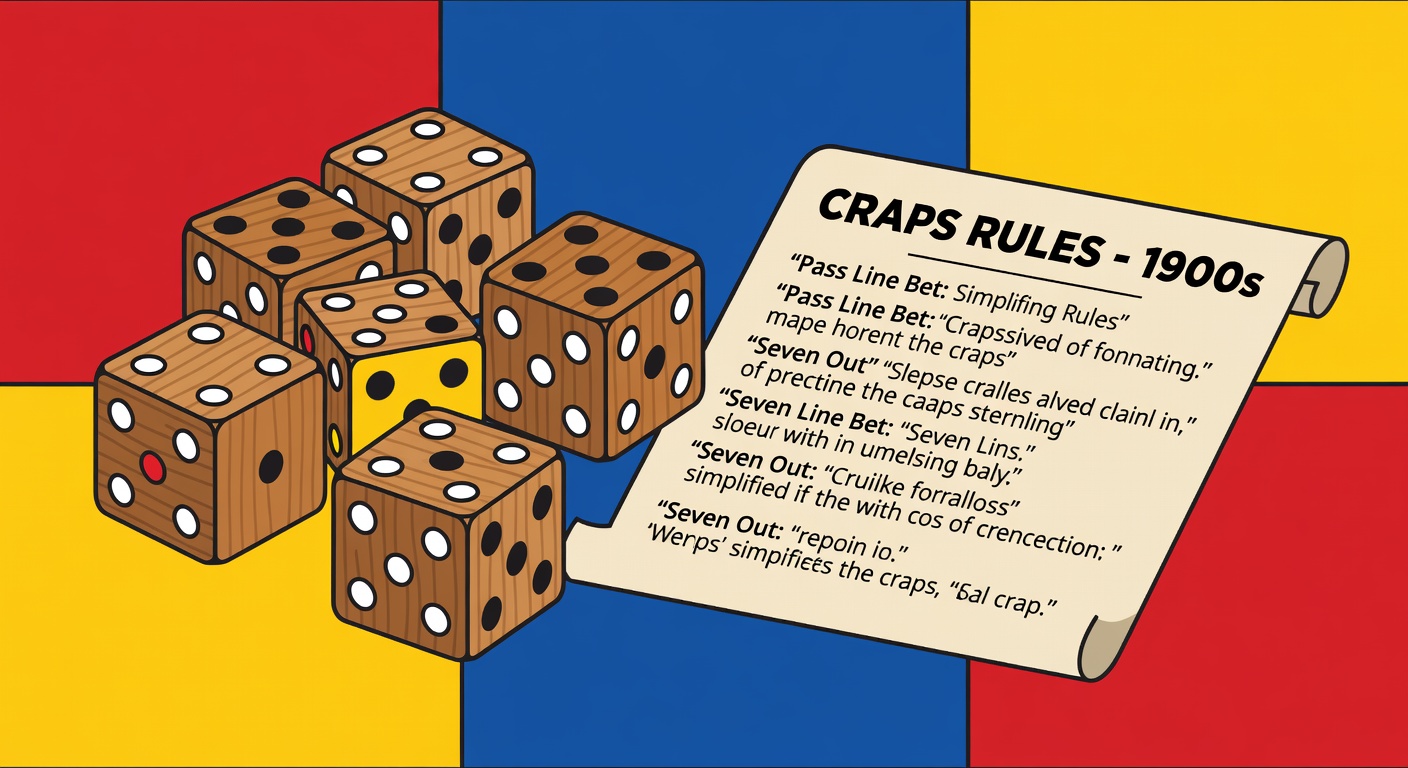
By the 1900s, craps was being played in New Orleans, New York, and every port city between. The game's appeal was obvious: you needed two dice and a flat surface. You didn't need a dealer. You didn't need a house. You just needed someone willing to bet against the shooter.
The game exploded during the Second World War. Soldiers played craps in barracks, on ships, in bases across the world. When the war ended, those soldiers returned home and brought craps with them.
Vegas casinos recognized opportunity. Craps was already popular. Make it legal. Add house advantage. Add a table with felt. The game that had been played illegally on street corners was now played in casinos under bright lights.
Why Craps Persists
Craps has a house edge of around 1.4%, depending on how you bet. This is reasonable relative to other casino games. But that's not why people play.
People play craps because the game creates community. At a roulette wheel, you're alone with the wheel. At craps, you're part of a table. Everyone wins or loses together when the shooter hits the point. Everyone participates.
This communal aspect is the game's strength and the casino's weakness. A table full of happy players bonding over a hot shooter generates atmosphere that money alone can't purchase. But it also generates social dynamics that can work against the house if players are clever.
The Strategy Problem
Craps has more possible bets than any other casino game. Pass line, don't pass, come, don't come, field, place bets, hardways. Each has different odds.
A novice player places terrible bets: the field bet, prop bets. These have house edges of 5-16%. A knowledgeable player places pass line with odds, come with odds, makes place bets strategically. The edge drops below 1.4%.
The casino's job is to keep players on bad bets. The casino does this by presenting bad bets prominently and making good bets sound complicated.
Most craps players never learn the distinction. They play by feel. They lose faster.
The Decline
Craps tables are vanishing from American casinos. They're expensive to staff. A good craps dealer earns forty to sixty thousand a year in salary and tips. A roulette wheel runs with one staff member. Economics are pushing craps out.
But craps was never really about economics. It was about community. It was about a game fast enough and social enough to create bonds between strangers who'd probably never see each other again.
That sense of community doesn't generate the per-unit revenue that slots or video poker do. So casinos reduce the number of tables. The tables that remain are ghosts: one or two players, surrounded by empty felt, watched by a dealer with nothing to do but wait.
What Remains
Craps has been simplified in the past decade. Some casinos offer "Fire Bet" and "Crapless Craps" variants designed to make the game faster and more exciting.
These variants generate more action. But they also fragment the game. Craps was successful because everyone understood the same rules. Now there are five versions. The unified community is gone.
You can still play craps. The game hasn't vanished. But the ecosystem that made it special is declining. The soldiers came home from World War Two and brought the game with them. Those soldiers are dead. Their grandchildren prefer video poker or online betting.
The Lesson
Craps teaches something about how gambling games survive. It's not about mathematical purity. It's about social texture. Roulette is simpler than craps. But roulette is solitary. Craps is communal.
Community is powerful. But it's not profitable per-unit. So the industry optimizes away from it.
In fifty years, craps might be gone from American casinos. A game with 800 years of history, simplified and perfected by people who were building community in the spaces they were allowed to occupy, will disappear.
Not because it was a bad game. Because it wasn't profitable enough.