A reload bonus is a lump-sum gift. You deposit $500. The casino adds $250. You now have $750. Simple. Transparent. And almost always a trap.
Rakeback is subtler. The casino takes 2 or 3 percent of every dollar you wager and puts it in a comp account. You do not see it happen. At the end of the week, you have accumulated a pool. It can be withdrawn.
For casual players, reload bonuses look better. Immediate gratification. A big number on the screen. But for table game regulars, rakeback wins almost every time. Here is why.
The Reload Math
A reload bonus comes with playthrough requirements. You must wager $250 x 35, so $8,750, before withdrawal. That deposit-match structure is nearly universal. The percentage varies, but 50 percent matches are standard.
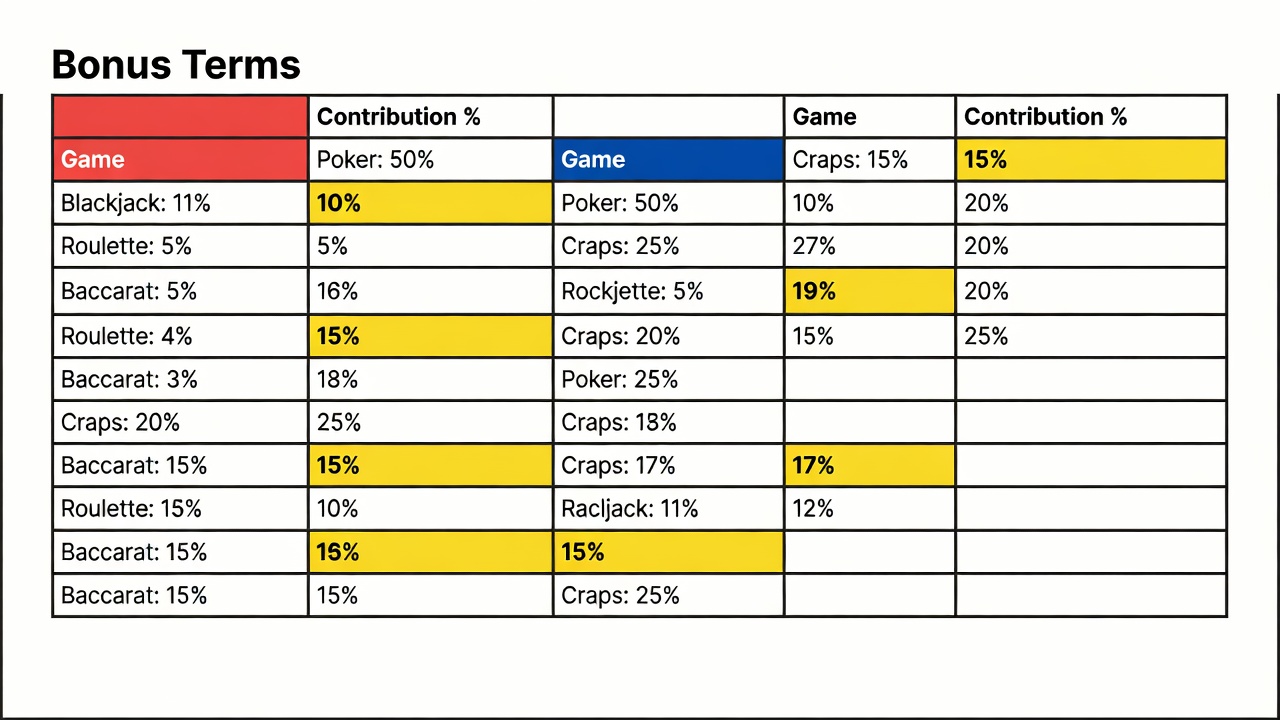
Now, what counts toward playthrough? Nearly everything, with some exceptions. Slots count 100 percent. Table games count 10 to 30 percent. Live dealer blackjack counts 5 to 15 percent. In other words, if you play table games, a reload bonus has built-in friction. You need to run up enormous wager volume to clear it.
A $250 bonus on table games means playing through $250 x 35 = $8,750 in bets. If table games count at 20 percent (a common rate), then you need to wager $43,750 in actual play to satisfy the requirement. That is roughly 87 hands of blackjack at $500 per hand. The house edge on blackjack is 0.5 to 1.5 percent depending on the variant. Your expected loss is $219 to $656. The bonus you received was $250. Depending on variance, you may not clear the requirement before busting.
The Rakeback Advantage
Rakeback accrues as you play. It does not come with playthrough strings. It is not a bonus; it is a rebate on turnover.
At 2 percent rakeback, every $1,000 wagered nets you $20. If you wager $43,750 (the same volume as the reload example), you receive $875. That is more than triple the reload.
Moreover, rakeback accrues regardless of outcome. If you lose $2,000 playing baccarat, and that $2,000 in play generates $40 in rakeback, you receive the $40. The reload, by contrast, vanishes if you lose the playthrough roll.
Hidden Terms
Reload bonuses often come with other restrictions. Maximum bet caps while clearing the bonus (often $10 to $50 per hand). No game restrictions once the bonus is cleared, but yes, they exist during the rollover. Some bonuses expire after 7 days. Some are non-withdrawable, meaning the bonus amount itself disappears after you clear it; only your net winnings can be withdrawn.
Rakeback has none of these. It is earned incrementally, applied to your account balance immediately, and withdrawable whenever you want.
The Psychology of the Offer
Casinos advertise reload bonuses heavily because they work psychologically. A 50 percent bonus creates a false sense of edge. Deposit $500, receive $250, feel like you have a 50 percent bump. The playthrough requirement makes that bump temporary and hard to cash out. Rakeback is invisible until you notice it accumulating. No flash. No hype. Just steady value.
For a table game player making deposits of $1,000 to $5,000 per month, rakeback at 2 to 3 percent is worth $240 to $1,800 annually. Reload bonuses, if you do clear them, might yield $100 to $300 per bonus, and you can only take them once per month. Rakeback compounds.
The Regulatory Note
Both structures are legal in regulated jurisdictions. The MGA allows both. The UKGC allows both. Curacao eGaming operators offer both. The question is not legality; it is value capture.
For someone who plays blackjack, baccarat, or poker regularly, ask the casino about rakeback first. If they do not offer it, take the reload bonus if the playthrough is low (under 30x) and the game weight is favorable. Otherwise, save the effort.