I ran surveillance at a major Strip casino for fifteen years. I watched dealers work. I watched people cheat. I saw every angle. When live dealer casinos became a thing, I looked at them and saw something I recognized: a small casino, broadcast over the internet, with all the same problems and solutions scaled down.
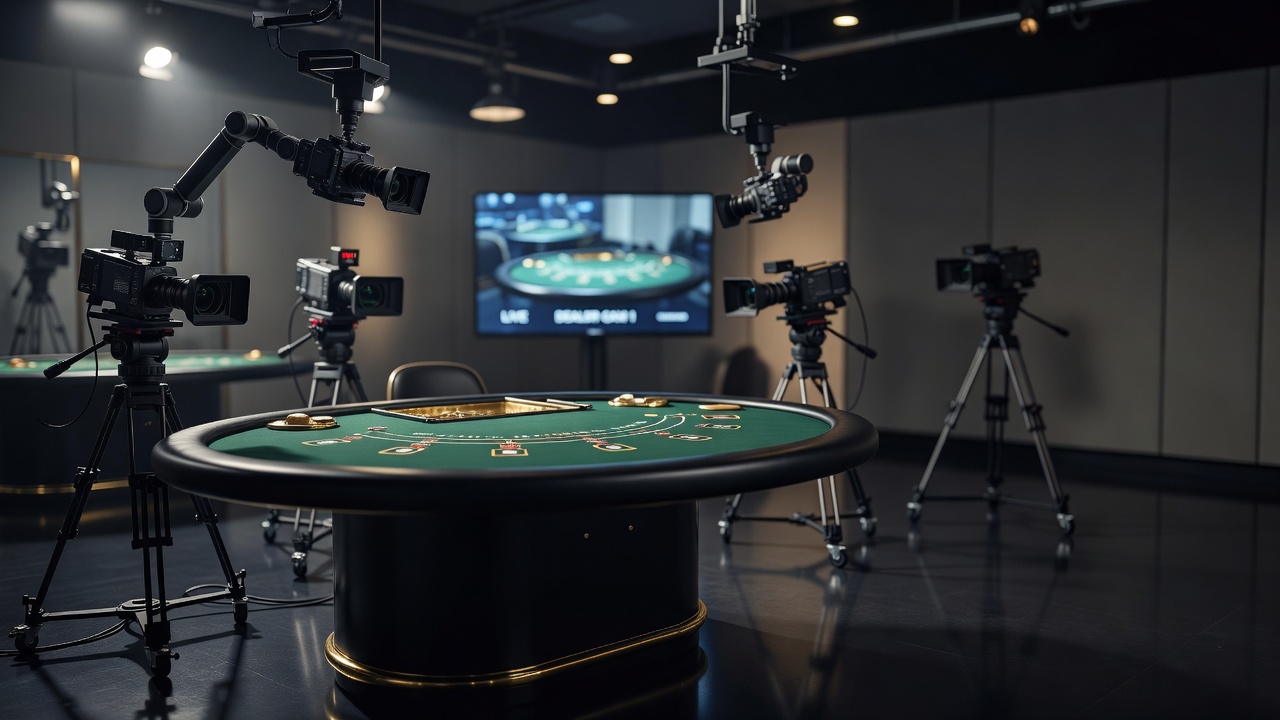
A live dealer operation is a studio. Typically in Malta, Romania, or the Philippines (lower labor costs). It has real cards, real roulette wheels, real tables. The dealer is real. A camera or multiple cameras broadcast the action. Players watch on their devices and place bets via a betting interface. The broadcast is live.
The Physical Setup
The studio is usually a warehouse-style space. Multiple tables running simultaneously. A roulette table. A few blackjack tables. Baccarat is popular because it's simple and high-volume. Some studios add poker variants or game shows.
Each table has three to five cameras. One wide shot of the table and players (though there are no physical players, so this is just the table layout). Close-ups of the cards being dealt. Close-up of the wheel for roulette. The feeds are edited and multiplexed. The player sees the angle that makes sense for the game.
Lighting is bright. The dealer needs to be visible. The cards need to be readable. This is different from a live casino where dealers work in dim lighting with the eye-in-the-sky compensating with infrared.
The audio is critical. You hear the dealer, the wheel, the cards. No music. The ambient sound adds authenticity. It's a calculated choice.
The Broadcast
The broadcast is encrypted and streamed to a content delivery network. The operator's software receives the stream, overlays the betting interface, and displays it to players. The delay is typically two to six seconds. This is latency. It exists because of network infrastructure, not because the studio is far away.
A two-second delay is acceptable for most players. It means you see the roulette ball drop, it bounces, it settles, and then you see the result two seconds later. For blackjack, you place a bet, the dealer sees it (with delay), and deals the hand.
Where latency becomes a problem: roulette. Some jurisdictions require the betting window to close before the wheel spins (no betting during the spin itself). If you have a six-second delay and the betting window closes after four seconds, you're blind. The wheel is spinning, you can't see it clearly, and you're locked out of betting decisions.
Good operators manage this with countdowns and clear visual signals. When the wheel is about to spin, a countdown appears. Players know they have two seconds to place final bets. The betting window closes. The wheel spins. Players watch the result.
The Dealer's Job
The dealer is an employee of the studio. They're trained to deal cards slowly, announce each action clearly, and work at a consistent pace. Their pace is slower than a live casino because they're broadcasting and players need time to process information.
A live casino blackjack table might deal 60 hands per hour. A broadcast blackjack table deals 30 to 40. The slower pace is intentional. Players need time to see cards clearly, make decisions, and place bets for the next hand.
The dealer doesn't see the players. They see a screen showing bets placed. They work off of that. In some studios, a supervisor watches the camera feed and can communicate to the dealer if something seems wrong.
The Cheat Problem
Here's where my background matters. In a physical casino, I caught cheating through surveillance. In a broadcast environment, cheating is different.
Player-side cheating is hard. The player places a bet. The outcome is determined by cards or a wheel they don't control. They can't influence it.
Dealer cheating is theoretically possible. A dealer could work with an operator to rig outcomes. But here's the security architecture: the cards, the wheel, and the table are examined regularly by the studio's compliance officer. The broadcast is recorded. The regulator can request footage and audit it. Any pattern of unusual outcomes can be detected statistically.
Most live studios are audited monthly by the operator's internal compliance team and quarterly by the regulator. Gaming Laboratories International (GLI) and similar firms perform RNG testing on the shuffle algorithms and wheel balance.
Is it foolproof? No. But it's harder to cheat than in an unregulated environment.
The Player Experience
The appeal of live dealer is simple: it feels real. You see cards. You see a wheel. You see another human. It's not an algorithm. Even though the RNG is still there (the shuffle is randomized, the wheel balance is calibrated), the presence of a real person changes perception.
Most players prefer live dealer for baccarat and roulette. Less so for blackjack. The latency is annoying, and the gameplay is functionally identical to RNG-based blackjack once you account for the delay.
The downside: live dealer games have slightly higher house edges than their RNG equivalents. A live baccarat table might be 1.25 percent house edge (compared to 1.06 percent RNG). This is because the studio costs money to run. Staffing, equipment, licensing. That cost is passed to the player through slightly worse odds.
But players pay it. The experience of watching a real wheel spin is worth the percentage points.
Regulation
Live studios must be licensed. Most are operated by licensed gaming software providers like Evolution Gaming, Pragmatic Play, or Playtech. The studio location must comply with local labor laws. The broadcast must be encrypted. The betting interface must be audited for fairness.
When you play at a live dealer table offered by Bet365 or DraftKings, you're accessing a studio operated under contract by a licensed provider. The regulator can inspect the studio. They can watch the broadcasts. They can audit the mathematics.
Unregulated live dealer studios exist. They work the same way technically. But there's no oversight. A corrupt studio could deal cards from a marked deck. Nobody would know. This is why you stick to operators licensed by UKGC, MGA, or similar.
Live dealer is a bridge between the authentic experience of a live casino and the convenience of online play. It works because the technology is transparent. You're not trusting an algorithm. You're trusting your eyes.