The integrity monitor doesn't wear a suit, because the best security work happens where no one is looking.
Before the 2010s, sports betting integrity lived in a phone call between a casino manager and an FBI agent. A suspicious pattern in the betting action. An unusual line move. A whispered conversation. The industry relied on gatekeepers and personal relationships. It worked surprisingly well and terribly poorly at the same time.
The Mechanism of Surveillance
In 1998, a low-level Italian footballer named Fabrizio Miccoli placed a two-hundred-euro bet at a Roman betting shop. He bet that his own team would lose. His team did lose. Miccoli walked away three thousand euros richer. The betting shop owner knew something was wrong but had no system to flag it. Miccoli played for Lecce. Lecce lost the match and their place in Serie A. The match-fixing investigation happened months later, after the fact.
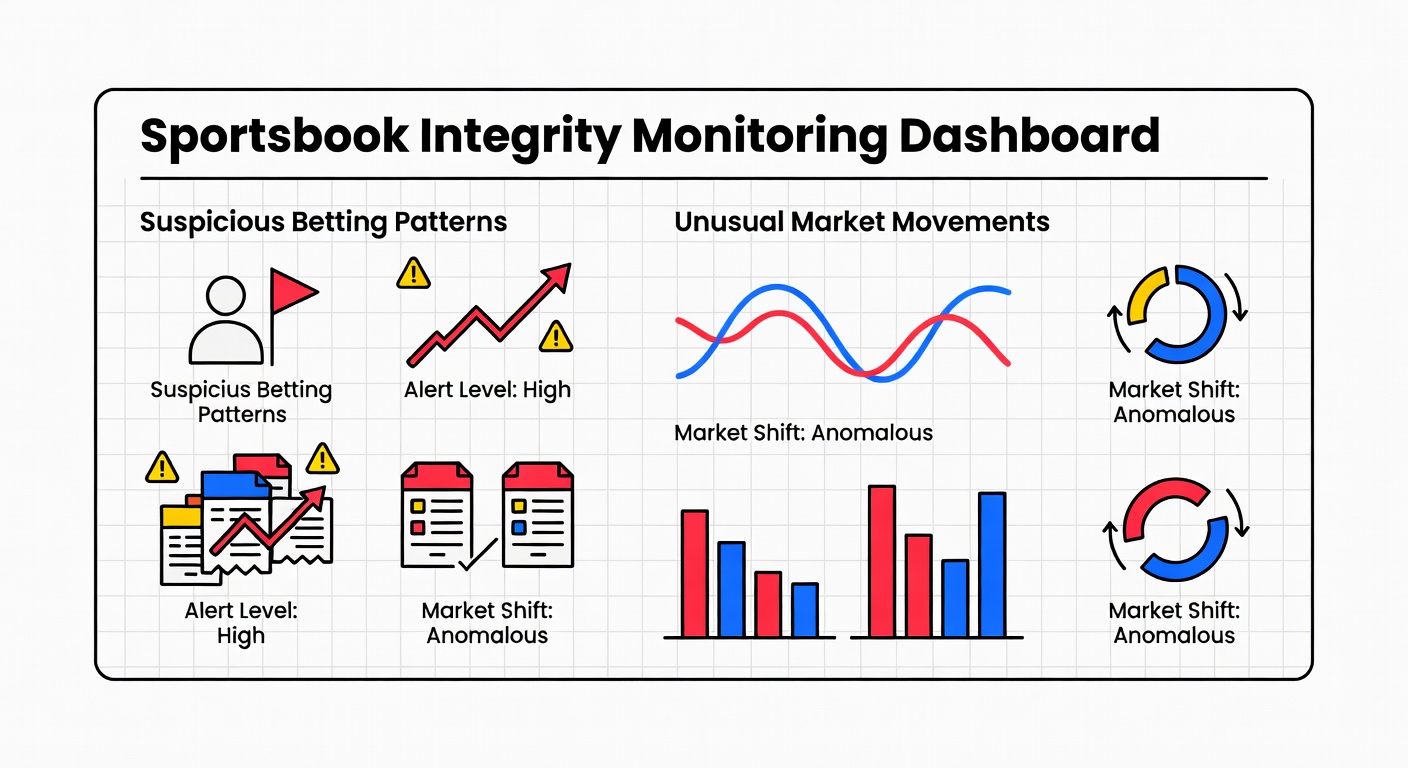
Modern integrity monitoring catches this in real-time or near-real-time. An anomalous bet triggers an algorithm. The algorithm checks betting volume, line movement, historical patterns, and player action. Does this bet suggest someone with inside information? Does it suggest coordinated betting? Does it suggest someone hedging a fixed outcome?
The system sounds like magic from the outside: you place a bet at a licensed sportsbook and instantly, somewhere, a computer algorithm has evaluated if you're a cheater. In reality, the mechanism is boring and mathematical.
How the Data Lives
Integrity monitoring services work for multiple sportsbooks simultaneously. They see all the bets across all the books. This visibility is the secret. A single person placing a ten-thousand-dollar bet on an obscure third-division football match looks like an outlier. But if seventeen people place similar bets on that match across fifteen different platforms, the pattern becomes visible only to the person watching all seventeen.
Licensed sportsbooks share limited data with integrity providers. They share the bet, the odds, the time, the amount, and the outcome. They don't share the bettor's identity (though Suspicious Bet Reports can be filed when integrity staff recommend it). The integrity provider can flag the pattern without exposing any bettor to unnecessary scrutiny.
This compartmentalization is important. Most players who trigger the system aren't criminals. They're sharp bettors with models that work. The model predicts a mispriced line. The sharp bets accordingly. The algorithm flags the pattern. The operator verifies that it's not fraud and continues.
What Actually Gets Caught
Match-fixing is the classic integrity threat. An athlete, referee, or team official is paid to influence the outcome. They perform in a predictable way. The betting pattern preceding the event should show a spike in action on the favorable side. The line should move in a way that reflects this action.
In 2012, the International Betting Integrity Association noticed unusual line movement on a second-division tennis match in Hungary. Forty thousand euros in betting action on a match that typically saw eight thousand. The line moved from heavy underdog to near-even. The match went to the heavy underdog. Investigation revealed that two players on the favored side had been paid two-hundred-fifty thousand euros by match-fixers to underperform.
What caught them wasn't human intuition. It was anomalous volume hitting an obscure match followed by anomalous outcome. The algorithm doesn't make moral judgments. It detects deviation from expected distributions.
The Blind Spot in the System
Integrity monitoring works beautifully for events where volume is normally predictable. Tennis is lightly bet in most markets. A spike is visible. Professional football is heavily bet in most markets. A spike can hide in the noise.
Colluded betting (multiple people betting coordinated amounts) becomes harder to detect when the amounts are small enough to avoid triggering individual thresholds. If a match-fixing scheme uses fifty different people, each betting two thousand instead of one person betting one-hundred thousand, the system sees many small bets rather than one huge one.
The other blind spot: regulatory arbitrage. A match-fixer in a low-regulation jurisdiction can place bets at unlicensed operators where there is no integrity monitoring at all. The advantage still flows to the fixer, but the detection system has no visibility.
The Value Proposition
For licensed sportsbooks, integrity monitoring is insurance against regulatory penalties. A jurisdiction that licenses sportsbooks also writes rules about fraud prevention. If fraud happens and you didn't have systems to detect it, you lose your license. With integrity monitoring, you have a record showing you were monitoring. Even if fraud slips through, you can show you had systems in place.
For the bettor, integrity monitoring should theoretically make the market fairer. The sharps who trade illicit information get caught earlier. The field plays against a cleaner set of odds. But sharp bettors also move markets legitimately. The system has to distinguish between a legitimate information edge and a fraudulent one.
This is why the evaluation is so dependent on pattern-matching. The computer sees the bet and the outcome. A human has to evaluate the method. How did this person know? If the answer is "they're a genius," the bet stands. If the answer is "they bribed the referee," the bet is voided.
The system works best for obvious crimes. It works less well for subtle edges that walk the line between sharp betting and fraud.