Why Most Casino Bonuses Have Low Table Game Contributions
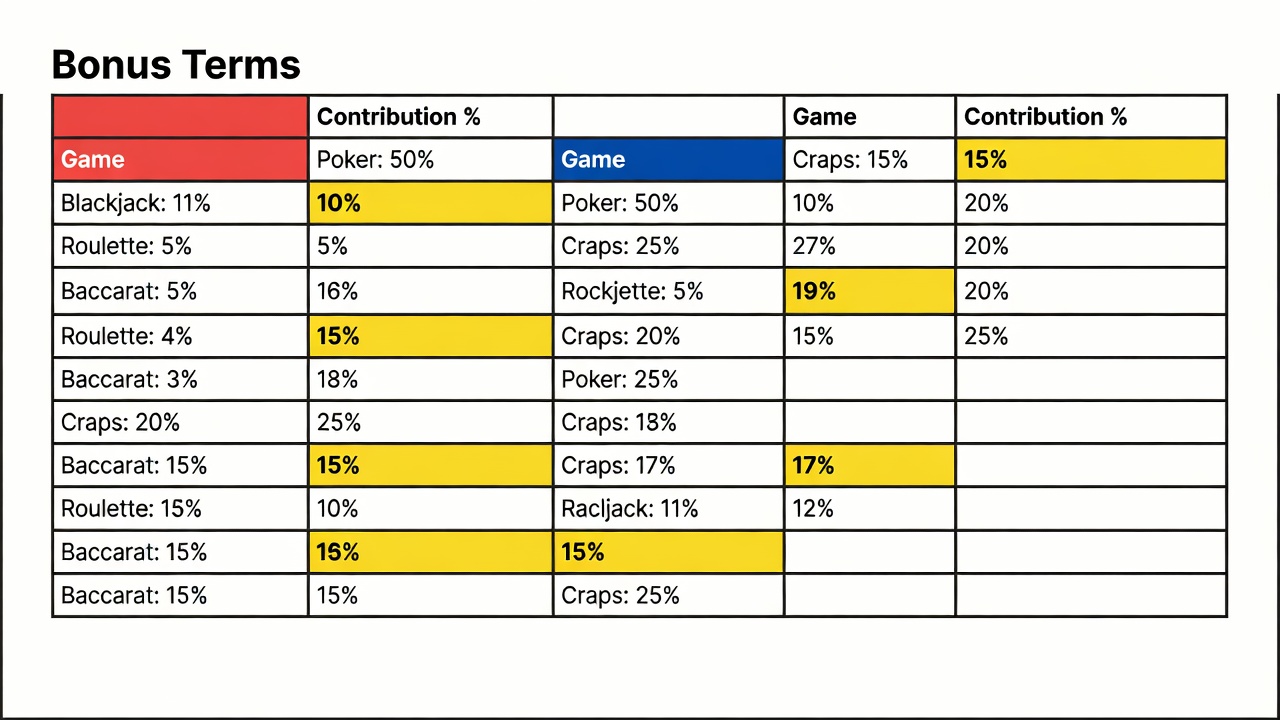
Watch a sportsbook bonus and tell me what you see. One hundred percent match, okay. But read the fine print. Slots contribute 100% toward playthrough. Table games contribute 25%.
Lights out
Watch a sportsbook bonus and tell me what you see. One hundred percent match, okay. But read the fine print. Slots contribute 100% toward playthrough. Table games contribute 25%. Live dealer contributes 5%.
Why the discrepancy? Because slots are a cash printer for the house and table games are a leaky bucket.
The House Edge Difference
Slots: 2% to 8% house edge depending on the game. A player wagers $1,000 on slots, the house expects to win $20-80 depending on volatility.
Blackjack: 0.5% to 1% house edge for basic strategy players. A player wagers $1,000 on blackjack, the house expects to win $5-10.
Baccarat: 1% to 1.5% house edge depending on which bet. Similar to blackjack.
A player betting bonus money on slots is money in the bank. A player betting bonus money on table games is a closer call.
The Skill Variable
Slots: pure chance. No skill. A player cannot reduce the house edge through smart play.
Table games: some skill possible. A blackjack player using basic strategy cuts the house edge to 0.5%. A baccarat player taking banker consistently (better odds) reduces their house edge.
A skilled player on table games can significantly extend their bonus playthrough while losing less money. This cuts the casino's profit margin.
The Math
100% match bonus on slots (100x playthrough): Player deposits $500, gets $500. Must wager $50,000. Expected loss on slots at 3% edge: $1,500. Net for player: minus $1,000.
100% match bonus on blackjack (100x playthrough): Player deposits $500, gets $500. Must wager $50,000. Expected loss on blackjack with basic strategy at 0.6% edge: $300. Net for player: plus $200.
The casino cannot afford a bonus structure that lets players win. So they restrict table games to 25% contribution. Now the blackjack player needs to wager $200,000 total to complete the playthrough. Expected loss: $1,200. Bonus no longer profitable for the player.
The Control
Casinos are managing the bonus math backwards. Instead of saying "no table games," they say "table games at 25% contribution." This sounds less restrictive but achieves the same result.
A player sees 25% and thinks: okay, I can play some blackjack. They place $100 on a hand. It counts as $25 toward playthrough. They need to play 4,000 blackjack hands to complete a $50,000 playthrough. That is 40-50 hours of gameplay.
Over 50 hours, even a skilled blackjack player will lose money through variance and short-term luck. The math catches up.
The Play
A sharp bonus hunter understands this immediately. They look at contribution percentages. If table games are restricted, the bonus is unlikely to be profitable. They skip the bonus and bet normally.
A casual player sees a generous bonus and deposits. Then they discover the contribution structure makes the bonus impossible to clear profitably. They lose the bonus and a portion of their deposit.
This is by design. The bonus attracts players. The contribution structure ensures the casino profits regardless.
The Bottom Line
Bonuses with low table game contribution are bonuses structured for slots players only. Slots players should take them. Table game players should avoid them. If a bonus treats all games equally, that bonus is unusually generous and probably worth playing.